
Last reviewed: November 2026.
One of the quickest ways to lose leverage in a business sale is for the wrong people to learn about it too early. A rumor that reaches your key employees, your largest customer or a local competitor can cause resignations, lost accounts and nervous suppliers, often while a buyer is still checking whether your earnings will hold up.
A confidential sale process manages who learns what, and when. This guide explains why confidentiality affects your price, how blind profiles, NDAs and buyer screening work in practice, what an NDA can and can’t do, and how to handle the moments when people inevitably start asking questions.
What Can Happen When a Sale Leaks Early
- Key employees start looking elsewhere. People worry about their jobs under a new owner. If a key manager or technician leaves during due diligence, the buyer may lower the offer or walk away.
- Customers hedge. Commercial clients may start talking to other vendors “just in case,” and competitors can use the news to approach them.
- Competitors use it. A rival who knows you’re selling can tell shared prospects your company is in transition.
- Suppliers and landlords get cautious. Credit terms can tighten, and lease conversations can stall until the landlord knows who the buyer is.
- Buyers sense pressure. If the sale is common knowledge, buyers may assume you need to sell quickly and offer accordingly.
None of this is certain to happen. But each risk lands at the worst possible time, while a buyer is still deciding.
How a Confidential Sale Process Works
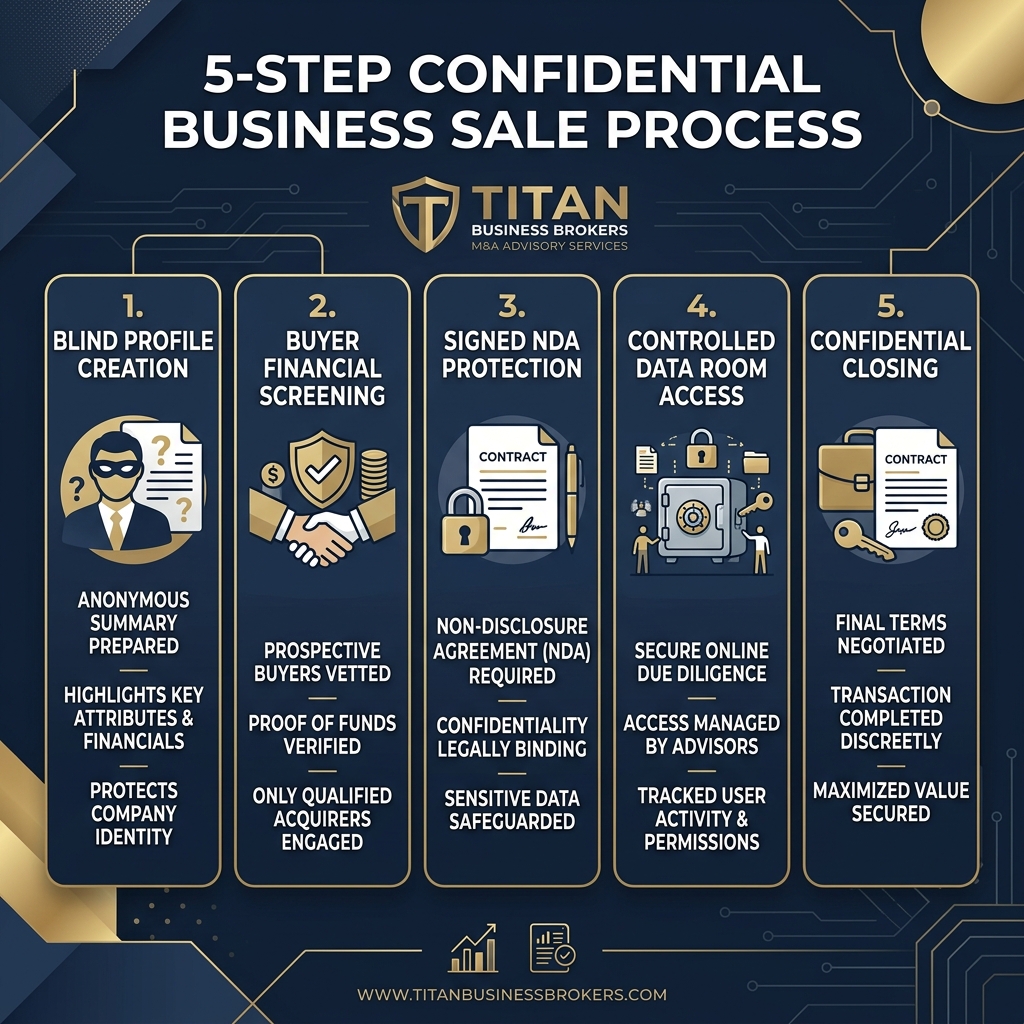
Step 1: A blind profile
The broker writes a short anonymous summary, often called a teaser, that describes the industry, general region, revenue range and cash flow without naming the business or including identifying details. “Established commercial HVAC contractor, New Haven County” tells a buyer enough to be interested and a neighbor too little to guess.
The art is in what’s left out. A founding year, a niche award, a distinctive service or a small-town location can identify a business in minutes. A good blind profile is tested by asking: could someone local figure out who this is?
Step 2: Screening before anything is shared
Before a buyer learns the name of the business, the broker confirms who they are, what funds and financing capacity they have, what experience they bring and why they want to buy. Screening is what keeps direct competitors, curious locals and buyers who can’t close out of your files.
Step 3: A non-disclosure agreement
Qualified buyers sign an NDA before receiving identifying information. A typical business-sale NDA requires the buyer to keep the opportunity and the information confidential, use it only to evaluate the purchase, avoid contacting your employees, customers, suppliers or landlord without permission, and return or destroy the materials if they walk away. Terms vary, so have your attorney review the form your broker uses.
Step 4: The confidential information memorandum
Once a buyer is screened and under NDA, they receive the confidential information memorandum (CIM): the business’s name, history, operations, staffing overview and normalized financials. Highly sensitive items, such as customer names, employee names and pay, and supplier pricing, are usually held back until a letter of intent is signed. See our documents checklist for what’s shared at each stage.
Step 5: Controlled visits and data room access
Site visits are scheduled when they’ll draw the least attention, often outside business hours or on quieter days, and buyers are asked not to talk with staff. Detailed records are shared through an online data room where access can be limited to specific people, set to view-only, watermarked, logged and revoked. Those controls reduce risk and create a record of who saw what. They can’t make it impossible for someone to copy or photograph a document, which is why screening and the NDA come first.
What an NDA Can and Can’t Do
An NDA gives you legal recourse if a buyer misuses your information, and it sets clear expectations. It doesn’t stop someone determined to misuse it, and enforcing one costs time and money. That’s why the real protection comes in layers:
- screening before the NDA is even offered,
- releasing information in stages as the buyer’s commitment grows,
- holding the most sensitive details until after a letter of intent, and
- handling direct competitors differently, with your approval first and often stricter terms or delayed disclosure.
Public Sale vs. Confidential Brokered Sale
| Stage | Unmanaged sale | Confidential process |
|---|---|---|
| Listing | Identifying details visible | Blind profile: industry, region, financial range |
| Inquiries | Come straight to the owner’s phone and email | Routed through the broker and screened |
| Competitors | Can pose as buyers or recognize the listing | Identified during screening; disclosure only with owner approval |
| NDA | Signed late or not at all | Required before the business name is shared |
| Sensitive data | Shared early to keep buyers interested | Released in stages; most sensitive after a letter of intent |
| Site visits | During business hours, with staff questions | Scheduled to limit attention; buyers briefed on conduct |
When and How to Tell Employees
For most small businesses, the broad announcement comes at or right after closing, ideally with the new owner present to answer questions and reassure people about their jobs.
The exception is the small number of people the buyer needs to meet before closing, usually a general manager or a key technician whose staying is part of the deal. Those conversations typically happen late in due diligence, with a confidentiality agreement and often a retention or stay bonus tied to a successful transition. Talk to your attorney and CPA about how such a bonus is structured and paid.
If you have to bring someone in earlier, for example a bookkeeper who will be pulling records, tell them directly and ask for confidentiality, rather than inventing a cover story. Trust that’s lost when a cover story falls apart is hard to rebuild, and the people you’re most worried about losing are usually the ones most likely to see through it.
If Rumors Start
Rumors happen even in well-run processes. If someone asks, don’t lie, and don’t announce a deal that may never close. An honest, steady answer works: you’re always looking at the long-term future of the business, nothing is changing today, and you’ll share news when there is news to share. Then talk to your broker about whether anything in the process needs to tighten up.
Confidentiality and Financing
If the buyer is using an SBA loan or other bank financing, the lender will need detailed information about the business, including financial statements and tax information. Under current SBA rules, lenders verify a seller’s financial information against IRS tax transcripts. Lenders and their appraisers are professional parties who handle this information routinely, but they are additional people who will see your records, so build them into your disclosure plan.
Common Mistakes Owners Make Trying to Sell Quietly
- A listing that’s too specific. Exact founding year, niche awards, a small-town name, a distinctive service. Each one narrows the field.
- Taking buyer calls at the business. Repeated hushed calls get noticed. Use a private line and private times.
- Accepting an NDA without screening. A signature from someone who can’t buy still puts your numbers in their hands.
- Sharing customer and employee details too early. Hold them until a letter of intent and formal due diligence.
- Meeting buyers near the business. In small markets, being seen reviewing spreadsheets with strangers invites questions.
Thinking About Buying?
Expect a professional broker to ask you for a signed NDA and evidence of your financial capacity before revealing a business’s name or location. That isn’t a hurdle aimed at you. It’s the same protection you’ll want for your business someday. See buying a business in Connecticut for how the buyer process works.
How Titan Handles Confidentiality
Your Titan advisor writes and tests your blind profile, screens every inquiry, manages NDAs and staged disclosure, and agrees with you in advance how competitors and site visits will be handled. You decide who learns the business’s name, and when. Learn more about how business brokers help sell a business or selling a business in Connecticut.
Working With Titan Business Brokers
Titan Business Brokers is a Connecticut-based brokerage headquartered in Wallingford, representing business owners and buyers across Connecticut, Massachusetts, New Jersey and New York. In Connecticut we work with owners in Fairfield County, New Haven County, Hartford County, Middlesex County and throughout the state. Visit our Connecticut business broker page, or read how we approach selling a business in Massachusetts, New Jersey and New York. If you are on the buying side, see our guide to buying a business in Connecticut.
Learn more about Titan’s Connecticut business brokers on our homepage, or meet the team on our About Us page.
Frequently Asked Questions
What is a confidential business sale?
A sale process where the business is marketed anonymously, and its identity is revealed only to screened buyers who have signed a non-disclosure agreement, with sensitive information released in stages.
Why does confidentiality affect the sale price?
Early leaks can cause employee turnover, customer losses and supplier caution during the period when a buyer is verifying your earnings. Each of these can lead to a lower offer or a lost deal.
What is a blind profile?
A short anonymous summary, also called a teaser, that describes the industry, general region and financial performance without identifying the business. It’s designed to attract qualified buyers without revealing who you are.
What does a business-sale NDA cover?
Typically: keeping the opportunity and information confidential, using it only to evaluate the purchase, not contacting employees, customers, suppliers or the landlord without permission, and returning or destroying materials if the buyer walks away. Terms, including how long the NDA lasts, vary by agreement.
Is an NDA enough to protect my business?
No. An NDA gives you legal recourse, but the practical protection comes from screening buyers first, releasing information in stages, and holding the most sensitive details until a letter of intent.
When should I tell my employees?
Usually at or right after closing, with the new owner present. Key people the buyer needs to meet are typically told late in due diligence, under a confidentiality agreement and often with a retention bonus.
How are site visits handled?
They’re scheduled to draw as little attention as possible, often outside normal hours, and buyers are asked not to approach staff. If someone needs to know why a visitor is there, it’s better to say little than to invent a story.
What if a competitor responds to my listing?
The broker should identify that during screening and consult you before anything is shared. Some owners decline. Others proceed with stricter terms or delayed disclosure, because a competitor can sometimes be the strongest buyer.
Does a virtual data room stop documents from being shared?
It reduces the risk. Access can be limited, logged, watermarked and revoked, but no system can fully stop someone from copying what they can see. That’s why screening and staged disclosure matter.
Can I sell my business confidentially on my own?
It’s harder. When inquiries come directly to you, buyers and competitors can often trace the listing back to your business, and you’re doing the screening yourself while running the company.
The Bottom Line
Confidentiality isn’t about hiding problems from buyers. Buyers will see everything before closing. It’s about protecting your employees, customers and cash flow while the deal comes together. Screening, NDAs, staged disclosure and honest communication keep your leverage intact through closing.
To talk through a quiet, well-managed exit, contact Titan Business Brokers.